 Skip to content


Red Mulch
Landscaping
Choose the shade with your house in view. Choose the material with your planting bed in mind.
Red mulch usually means wood or bark colored for a decorative finish. Look at the actual product, its source, the existing bed, and the total depth before deciding what to buy.
See the contrast.
Switch the wall and mulch colors to compare a simple landscape palette.
Light siding + rust red. Illustration only. Compare physical samples at your property before ordering.
Does the red color help plants?
The color is a design choice. Evaluate the mulch material and its use, rather than expecting red pigment to improve plant growth.
Is every red mulch the same?
No. Dyed wood, naturally reddish bark, rubber, and red growing films are different products. Read the material description.
Does fading mean add more?
Check the existing depth first. A dull surface can still cover a bed that needs no additional material.
What is red mulch made of?
For ornamental landscaping, red mulch commonly refers to chipped or shredded wood with an added colorant. “Red” tells you the appearance. It does not tell you the wood source, texture, intended use, or quality.
A bag of fine shredded wood and a coarse bulk product may both be sold as red mulch while looking quite different once spread. One can have a more even texture; another may contain larger pieces. Look beyond the front label and check the material description before comparing quantities or prices.
The Mulch & Soil Council’s colorant review discusses iron oxide as a red pigment used by the industry. That does not establish the ingredients of every product sold under a red-mulch name. Ask the supplier about the specific product instead of assuming that all brands use the same formula.
Dyed wood and naturally reddish bark
Some bark has a naturally warm or reddish-brown appearance. A product with added red colorant may be much brighter. Neither description tells you how the material will look beside your house, so compare a physical sample rather than treating “natural red” and “colored red” as interchangeable names.
Also separate the gardening use of the word organic from a product certification claim. In mulch discussions, organic often means a plant-based material that decomposes. It does not automatically mean dye-free, organically certified, or suitable for every planting. The actual ingredients and label matter more than the general term.
The wood source deserves a question
Ask whether the product uses forest-derived wood, bark, reprocessed wood, or a blend. If reprocessed material is included, ask how the source is controlled and screened. Do not judge the answer from color alone. A bright, even red surface cannot tell you what was used to manufacture the mulch.
The Mulch & Soil Council certification program checks labeling and product standards and includes chemical testing for CCA-treated wood contaminants in mulches. Certification is useful information to check on the exact product. It is not a blanket guarantee of safety or results, and the program does not certify color-duration claims.
Keep the supplier name, product description, and bag label or bulk delivery paperwork. Those details make it easier to ask a meaningful question later. “The red mulch from the garden center” gives you less to work with than a specific product name and purchase record.
Red rubber and red film belong in separate decisions
A red rubber landscape covering is not red wood mulch. A red plastic film sold for growing crops is another separate material. Neither should be substituted into this wood-mulch guide simply because its color matches. Their placement, maintenance, removal, and intended uses require their own product instructions.
If you want an ornamental bed around shrubs or a front entrance, start with materials intended for that use. For a broader comparison, our mulch selection guide explains how to choose by the job the material needs to do.
Where red mulch works in a landscape
Red mulch makes the ground plane visible. That can be useful when a planted bed needs a clear presence beside lawn or paving. It can also make a large, sparsely planted area feel dominated by the covering. Decide whether you want the bed itself to stand out or the plants to receive most of the attention.
Start from the street, front door, and driveway. A shade that looks attractive in a handful may read as a much stronger color across the front of a house. Include the roof, shutters, front door, masonry, and walkway in the decision. Those features occupy far more of the view than a product display at the supplier.

Light siding and neutral paving
Light walls and gray paving can give red mulch room to act as an accent. Try the sample beside the actual concrete, pavers, or stone, not only against the siding. A bright orange-red and a muted rust-red can produce quite different combinations even though both are called red.
Use a small tray or removable sample display. Place it where the bed will be visible, then stand back. Compare it with brown or a darker material. The point is to see the relationship among the colors, not to find a shade that looks most dramatic on its own.
Brick, warm stone, and an existing red door
When the house already has warm brick or strong red details, adding red mulch may repeat that color or compete with it. Check the undertones. A red with an orange cast can look different beside purple-brown brick than beside a warm terracotta surface.
A quieter brown finish may let the masonry and planting do more of the visual work. A darker finish can separate the bed from the wall. These are design choices, not rules about which mulch is horticulturally better. The color study above is a starting point; a sample beside your own house is the better test.
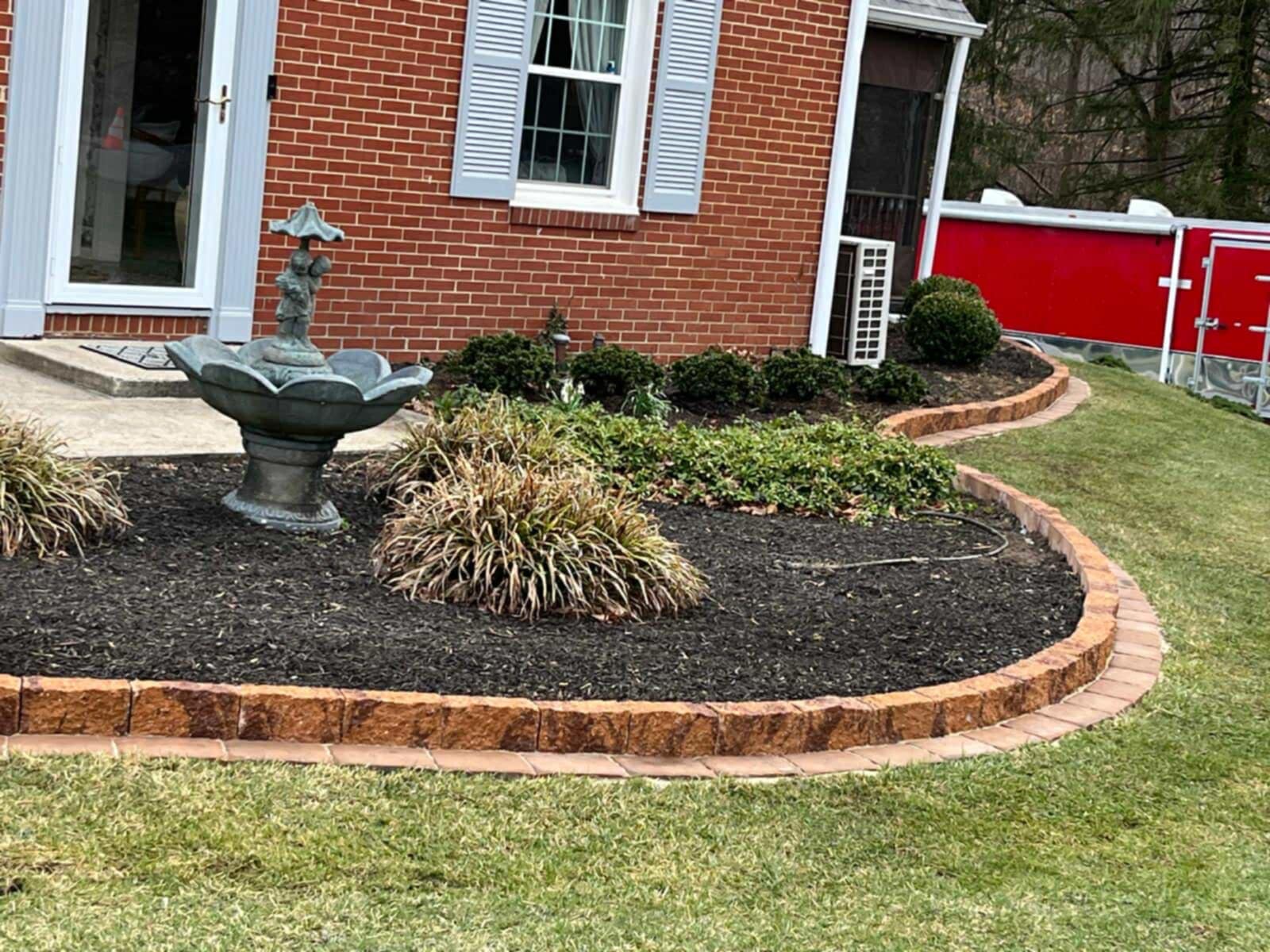
The border can change the choice.
This bed has more to coordinate than mulch and foliage. Include the border and house when comparing red with brown or dark mulch. Keep the original photograph as a design reference and test the proposed shade separately.
Small entrance beds and connected front-yard beds
A small entrance bed can support a stronger accent because the color occupies a limited area. Check whether the same choice still works when repeated across every foundation bed. You may prefer continuity, or you may decide the bright finish should stay within one defined area.
If two beds are seen together, compare them together. A bright red front bed beside a weathered brown side bed can make the transition more noticeable than expected. Plan the visible group of beds as a composition, even if the installation is completed in stages.
Plant growth changes how much mulch you see
New planting can leave broad areas of exposed covering. Established plants may hide much of it. Review the expected mature spread before choosing a color primarily for the gaps between small nursery plants.
Do not crowd plants simply to disguise a mulch choice you dislike. Settle the planting layout first, then choose a finish that works with it. If the beds need new plants, reshaping, or a different edge, discuss those decisions as part of the landscaping plan.
How deep should red wood mulch be?
Use the plant and material guidance to select the total finished depth. University of Maryland Extension recommends keeping mulch shallow, generally one to three inches around trees and shrubs, with about three inches of clearance from tree trunks and no contact with bark. Its mulching guide provides the context.
That is a total layer, including suitable material remaining in the bed. It is not an instruction to add that amount every time the surface loses color. Special plant needs can change the target; Extension’s excess mulch guidance gives boxwood as a shallow-rooted example needing less covering.
Measure several spots without digging into the soil or damaging roots. A bed may be deeper beside the house than near its outside edge. For uneven conditions, divide it into sections and calculate each separately. A single average is less useful when it hides an area that already has too much material.
A faded bed with a suitable layer needs a different plan from a bare bed. Decide whether existing material should stay, be redistributed, or be removed before calculating a new order. Color preference alone cannot answer that question.
Calculate the additional layer.
Enter measured net bed area and the depth of suitable mulch that will remain. Set a total target based on the plants, site, and product guidance.
Example: 240 sq ft × 1 inch ÷ 12 = 20 cu ft. At 2 cu ft per bag, that is 10 whole bags before any allowance.
Formula: additional depth = max(0, target − remaining). Cubic feet = net area × additional inches ÷ 12. Cubic yards = cubic feet ÷ 27. Whole bags round up after allowance. The displayed bulk figure is rounded for readability; confirm the supplier’s order increment.
Use the quantity as a planning figure
Measure irregular beds by breaking them into rectangles, triangles, and circles that are easier to calculate. Subtract sizable features and any areas that need to remain uncovered. Keep a sketch showing which measurements belong to which bed so you can review the numbers with the installer.
The same square footage can need different handling. A front bed beside a driveway and a rear bed reached through a narrow gate may use similar material volumes but require different work. The calculator estimates material, not the effort needed to prepare, deliver, carry, or spread it.
If your supplier sells bags of different sizes, compare the cubic feet rather than the bag count. Ten two-cubic-foot bags provide the same stated volume as twenty one-cubic-foot bags. Bulk orders use cubic yards, with 27 cubic feet in each cubic yard. Ask about delivery minimums and order increments before rounding a small estimate into a purchase.
Installing and maintaining red mulch
Agree on the bed preparation before the mulch arrives. A fresh covering does not complete unfinished edge work, remove established weeds, or identify why a planting area stays wet. Walk through the beds and decide what work belongs in the project.
- Confirm the material and the bed boundaries.
Match the product to the approved sample. Identify which beds are included, where the covering stops, and which existing plants, borders, or decorative features should be protected. Include hidden side beds in the scope if they are part of the job.
- Finish the agreed preparation.
Remove existing weeds and loose debris as appropriate. University of Minnesota Extension recommends weed removal before application in its mulching guide. Clarify any edge repair or old-material removal separately so it does not become an assumption.
- Spread according to the planned additional depth.
Keep the material within the defined bed. Review the measured layer as the work progresses, particularly where old mulch remains. Do not use surplus product as a reason to make a completed area deeper. Keep unused material for an appropriate later use or discuss its removal.
- Follow the exact product’s color-care instructions.
Colored products can have application-weather instructions. For example, Scotts Nature Scapes Color Enhanced Mulch directs users to keep it dry for 24 hours after application for longest color. That is a product example, not a universal rule for all red mulches.
How long does red mulch keep its color?
There is no one duration that applies to every red wood mulch. The Mulch & Soil Council notes that color duration varies with wood species, environmental exposure, and decomposition. A manufacturer’s color guarantee also has its own terms. Check the actual product and keep the purchase record if a claim matters to your decision.
Compare the appearance in different parts of the property over time. A bed partly sheltered by the house may not look the same as an exposed area. Photograph the finished beds from repeatable positions if you want a useful reference for future maintenance, rather than relying on memory of the original shade.
Before reacting to fading, identify what bothers you. It may be the color, scattered leaves, weeds, an untidy edge, or patches with different textures. Each calls for a different response. Buying a fresh load of red mulch addresses only one of those possible issues.
Color and plant care are separate checks
University of Minnesota Extension explains that plant-based mulch can reduce evaporation, moderate soil temperature, suppress weeds, and add organic matter as it decomposes. Those are material-and-application benefits. They do not establish that a red shade performs better than a comparable brown or undyed wood product.
University of Maryland Extension advises checking that irrigation reaches the soil beneath the covering. A wet-looking surface is not enough to assess moisture at the roots. Its excess-mulch guidance also explains the problems with deep buildup and moist bark. Inspect the bed itself when deciding what maintenance is needed.
Use plant growth, actual soil conditions, and the bed layout to guide care. Do not choose red mulch as a substitute for a watering plan, fertilizer assessment, or pest management. If a plant is declining, identify the cause before assuming the surface color is responsible.
Changing from red to another finish
Switching colors is a good time to review the entire bed. Check the remaining material, the edges, and the planting before ordering a new covering. A different shade on top may give the desired appearance in some areas, while deeper or unsuitable material needs a separate plan.
Ask to see how the proposed finish looks next to the material that will remain visible. If you want the old red completely removed, state that in the scope and discuss disposal. If some will stay underneath, agree on the preparation and total layer rather than assuming a cosmetic change requires the same work everywhere.
Buying red mulch in Harford and Baltimore counties
For a Maryland landscape project, local availability matters as much as an attractive online photograph. Ask to see the product being supplied for your order. A general red-mulch listing or a photo of last season’s display is less useful than a sample of the actual material.
Confirm whether the supplier sells bags or bulk, the stated volume, delivery details, and any minimum order. Ask how a small repeat order would be handled if you plan to complete the beds in stages. Keeping the product description consistent is more useful than asking only for the same color again.
| Decision | What should be clear |
|---|---|
| Material | Wood or bark description, source information, texture, exact product, and approved shade. |
| Quantity | Net area, suitable existing layer, additional quantity, allowance, and bag or bulk units. |
| Preparation | Weeding, debris cleanup, old-material handling, and edge work included in the job. |
| Delivery and access | Drop location, gates, steps, carrying distance, and protection of adjacent surfaces. |
| Completion | Spreading, cleanup, surplus handling, and any separate planting or border work. |
Compare volume rather than the lowest bag price
A low price per bag can be misleading when the bags contain different volumes. Divide the price by the stated cubic feet to compare material cost on the same basis. Then include the quantity you actually need, delivery, and the work required to install it.
Bulk is not automatically the better purchase for a small bed. Bags may suit a modest project or staged work; bulk may suit a larger installation with appropriate delivery access. Compare the complete purchase and handling plan before deciding which format makes sense.
What to send with an estimate request
Send a wide photograph of each bed, a closer view of the current covering, rough dimensions, and the product or shade you are considering. Include a photo of the path from the delivery area to the beds. Mention gates, steps, slopes, and any surfaces you want protected.
Explain the result you want in plain terms: a color change, a measured top-up, refreshed edges, or a wider landscape renovation. If the project includes new plants or garden borders, identify that work before comparing mulch estimates.
The Detail Guys provides mulching services from Edgewood for properties in Harford and Baltimore counties. Discuss the exact red product and its availability as part of the estimate. The scope should cover the condition of your beds and the preparation needed, rather than treating a color name as the whole specification.
Red mulch questions
Is red mulch better than black or brown mulch?
Color alone does not establish better plant performance. Compare the material, source, texture, intended use, and care instructions. Then choose the appearance with samples beside your house. Our black mulch guide covers that darker finish.
Does red mulch eliminate weeds?
No. A suitable covering can help suppress weeds, but it does not remove established growth or end maintenance. Plan the preparation and inspect the bed afterward. Do not use additional depth as the default response to every weed.
Can I put red mulch over old mulch?
It depends on what will remain and the finished layer needed. Assess the existing material, depth, and condition first. Enter only suitable mulch that will remain in the refresh calculator, and review uneven beds in separate sections.
Is red mulch dye the main quality issue?
The colorant is one part of the product. Check the wood source, ingredients, intended use, and product documentation too. A review of common industry pigments cannot verify the composition of an unidentified bag or bulk load.
Can I use red landscape mulch in a vegetable garden?
Do not infer suitability from color or an ornamental-bed photograph. Check the exact label and edible-garden guidance. Red plastic growing film is a different product from red wood mulch and requires a separate plan.
Should faded red mulch be replaced every year?
Use the bed’s condition to decide, rather than a fixed calendar or color change alone. Review the remaining layer and the actual work needed. If you prefer a new finish, agree on how the existing material will be handled before ordering.
How many two-cubic-foot bags equal a cubic yard?
A cubic yard is 27 cubic feet, which equals 13.5 two-cubic-foot bags. Buying 14 whole bags gives 28 cubic feet. Confirm the label volume and round up only after calculating the required quantity and any allowance.
Will The Detail Guys supply a specific red mulch brand?
Confirm the product and current availability when requesting an estimate. Share the sample, supplier, or brand you prefer so the material can be discussed along with preparation, delivery, and installation.
Sources behind the guidance
Design examples and the color study are illustrative. The quantity calculator uses the stated geometric formulas. Material and plant-care guidance draws on these primary sources:
- University of Maryland Extension: Mulching Trees and Shrubs
- University of Maryland Extension: Excess Mulch Problems
- University of Minnesota Extension: Mulching for Soil and Garden Health
- Mulch & Soil Council: Colorant Review
- Mulch & Soil Council: Product Certification and Limits
- Scotts: Nature Scapes Color Enhanced Mulch, a manufacturer example of product-specific color-care instructions.