 Skip to content


Garden Border Installation in Bel Air, Maryland
Garden borders give planting beds a clear edge beside lawns, walkways, and patios. The Detail Guys installs garden borders and raised flower bed features in Bel Air and surrounding communities in Harford and Baltimore counties.
The right border starts with its job. A low edge that separates mulch from grass needs a different plan from a raised bed that holds a deeper layer of soil. We can discuss the layout, material, and surrounding landscaping as part of your project.
Serving Bel Air, Edgewood, Abingdon, Forest Hill, and nearby areas.

What makes a garden border work well?
A clear purpose
Decide whether you need an edge for a planting bed, a defined mulch area, or a raised bed. These features can look similar while doing different jobs.
A practical layout
Allow for plants, mowing, walking routes, and access to the bed. A border should make the space easier to maintain, not create an awkward narrow strip.
A suitable material
Choose the appearance alongside the height, shape, and installation needs. Confirm the specific product and proposed construction before approving the work.
A border creates a visual separation, but it is not a guarantee against weeds or escaping mulch. Bed care, ground levels, and the amount of material inside the border still matter.
Garden edging, raised beds, and retaining walls
A tidy outline does not always require a tall border. Begin by describing what you want the feature to contain or separate.
| Feature | Main purpose | Planning question |
|---|---|---|
| Low garden edging | Defines the boundary between a planting bed and a nearby surface. | How will the edge meet the lawn, walkway, or patio? |
| Raised flower bed | Creates a planting area above the surrounding ground level. | How will soil, water, access, and planting depth be addressed? |
| Retaining wall | Retains soil where ground levels differ. | What site assessment and design does the retained soil require? |
If your main problem is a slope or soil moving from a higher area, describe that when you contact us. A decorative garden border should not be treated as a substitute for a retaining wall assessment.
Which garden border material should you choose?
Stone, brick, concrete products, metal, and wood create different appearances and need different installation details. Ask which options suit the intended use rather than choosing only from a photograph.
Stone, brick, and concrete products
These can create a visible outline or a more substantial bed edge. Discuss the product size, corners, caps where applicable, and how the finished height meets nearby surfaces.
A straight section and a tight curve may need different units or cuts. Check that the preferred material can produce the layout you want.
Metal and wood options
These may suit a different style or profile. Confirm the specific product, suitability for its intended use, and the care it will need over time.
Material names alone do not describe a complete installation. The estimate should identify the proposed option and what work is included.
Garden borders before and after
Each pair shows the same area before and after bed and border work. Drag or tap a picture, or select its slider and use the arrow keys. Viewpoints differ slightly.


These photographs show appearance and layout, not hidden construction details or specifications for another property.
Plan around mowing, plants, and water
A border can look good on installation day and still be inconvenient if there is no room to mow beside it or reach the planting bed. Walk through the proposed layout before settling on its shape.
Beside the lawn
Discuss the finished height and how the lawn will meet the edge. Consider whether the layout creates tight corners or small patches that are difficult to reach with your usual equipment.
Beside a walkway
Keep the normal walking route in mind. Plan for mature plant size so foliage does not overwhelm the path after planting.
At the bed surface
Review existing levels and where water collects. Raising an edge does not automatically solve drainage inside the bed or outside it.
Pairing the border with mulching services can finish the bed as one project. If plants, bed shape, or surrounding lawn need attention, include that work in a broader landscaping discussion.
Take extra care around existing trees
Do not treat a tree border as permission to pile soil or mulch against the trunk. University of Maryland Extension’s mulching guidance recommends keeping mulch away from tree trunks and avoiding excessive depth. Its tree planting depth guidance explains why a buried root flare is a concern.
For an established tree, discuss the existing roots and ground level before changing the bed. A photo of a finished border shows its appearance, not the root conditions beneath it or a suitable design for every tree.
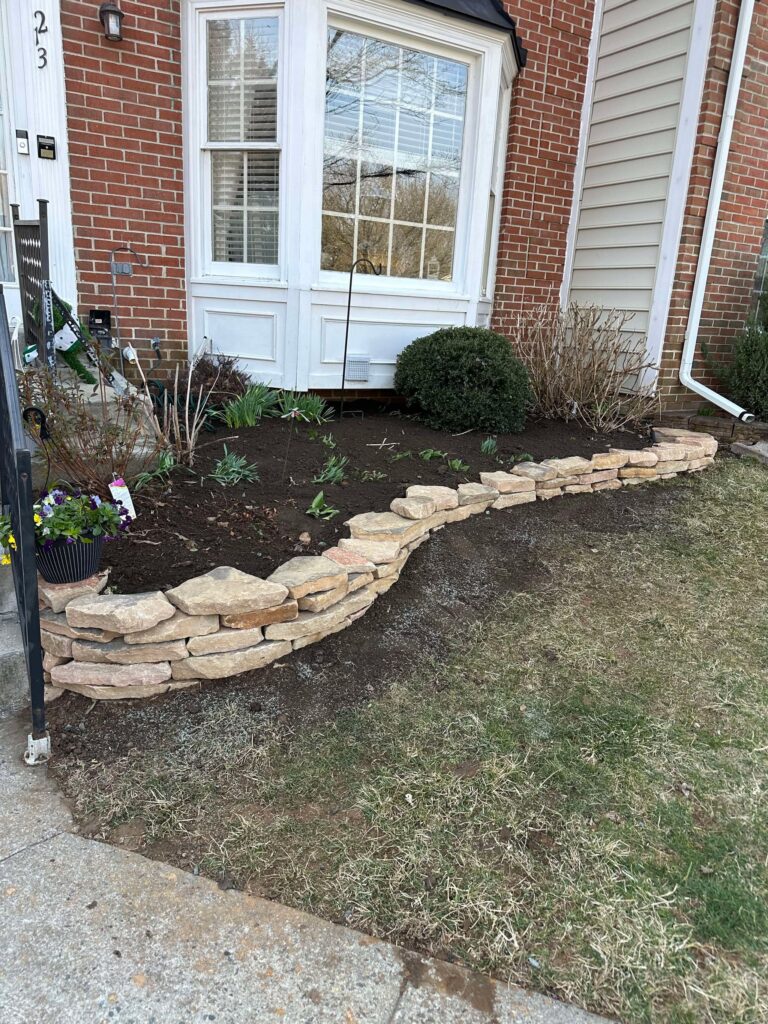
A border beside the entrance
The edge follows the planting area next to the front steps. Discuss the route and nearby access when planning your own bed.

Connections around the house
Several bed edges can be discussed together so the layout suits the surrounding yard.
Garden border length calculator
Estimate one straight run, the complete perimeter of a rectangle, or a full circular border. All measurements are in feet. For irregular beds or partial circles, measure the actual route rather than using a complete shape.
- Border length
- linear feet
- Metric equivalent
- meters
This is geometric length, not a material order or installation price. It excludes cuts, joints, waste, layers, caps, foundations, and drainage.
Discuss your border layoutThe sample measurements demonstrate the formulas. They are not a recommended bed size. This tool does not assess roots, retained soil, stability, drainage, or construction requirements.
What affects garden border installation cost?
The length is a useful starting measurement. Material, height, layout, removal work, and site conditions also affect the scope.
Shape and material
A simple straight run is different from multiple corners, tight curves, or a raised bed. Ask for the selected product and the complete layout to be identified in the proposal.
Existing conditions
Old edging, roots, changes in ground level, and access to the bed need to be reviewed. Photos help explain the project but cannot establish every condition.
Compare estimates by scope rather than length alone. Check whether the proposal includes removal of old material, preparation, installation, any agreed bed work, and cleanup. If you are adding plants or mulch, confirm those items separately.
What to send for a useful estimate
Send the property address, photographs of the whole bed and its edges, approximate measurements, and a description of what is not working now. Mention whether the bed sits against the house, surrounds a tree, or meets a patio.
Include a reference photo if you have a preferred appearance. Identify whether you want to keep the current bed shape or change it. If you want a raised bed, describe its planting purpose and access needs rather than selecting height from a photo alone.
Repair or replace an existing border?
A local repair may suit a limited damaged section if the remaining installation is serviceable and suitable materials can be matched. Widespread movement, an unsuitable layout, or a change in the intended use may point toward replacement.
Ask for the condition and cause to be reviewed before deciding. Simply putting moved pieces back in line may not address the reason they moved.
Garden border installation FAQs
Do you install garden borders in Bel Air?
The Detail Guys provides garden border installation in Bel Air and nearby communities in Harford and Baltimore counties. Share the address and photos to discuss your project and request a free estimate.
Will a garden border stop weeds?
A border defines the bed, but it does not eliminate weeds. Seeds can reach the bed and unwanted growth can still need attention. Plan for ongoing bed care rather than treating the border as a weed-proof barrier.
Can you install a border around an existing tree?
The tree, roots, and existing ground level need to be considered first. Avoid burying the trunk base or assuming that a raised ring is suitable. Discuss the proposed work before changing the soil or mulch level.
Can a garden border hold back a slope?
Holding back soil at a change in ground level may require a retaining wall assessment. Explain the height difference and the problem you are trying to solve so the appropriate feature can be considered.
Can borders and mulch be installed together?
Yes, you can discuss border installation and mulching as one project. Ask for both items to be included in the written scope, along with any removal or planting work you want.
How do I measure a curved border?
Measure along the intended route using a flexible tape or another suitable measuring method. A full circle can be estimated from its diameter, but an irregular curve needs its actual route measured. A straight line between its ends will understate the curve’s length.
Does the calculator tell me how many blocks to buy?
No. It measures geometric length. Block sizes, joints, cuts, corners, caps, layers, and the chosen layout determine the final quantity. Confirm the installation plan before ordering.
Request a garden border estimate
Tell The Detail Guys where you want the border, what it needs to do, and whether you also want mulch, planting, or adjacent paving. We can discuss a clear scope for your property.
Planning nearby paving? Explore our paver walkway, paver patio, and hardscaping services.